The Floral Game
9 ways to play
Choose a game, open its rules and keep this page handy while you play. The “petals” and “buds” sheets needed for the first two games are included below.
1 – Petal Me
Equipment
Floralyz cards, the “petals” sheet (pink), sheets of paper and pencils.
Definitions
- The petal: one aspect of our personality. The flower represents the whole person.
- The petaller: the player who suggests 3 words to another player, the “petalled” player. If the petaller guesses the right word, the petalled player is revealed.
- Draw pile: the deck placed face down in the centre.
- Discard pile: the deck placed face up beside the draw pile.
Set-up
Shuffle the cards and place the draw pile in the centre. Each player chooses one of their personality traits from the “petals” list and writes it on a sheet of paper without showing it.
How to play
On their turn, a player draws a card and looks at it without showing it. If it matches their chosen trait, they place it face up in front of them. Otherwise, they show it to the others: the first player to say “for me” may take it if it matches their own trait. If nobody wants it, it goes to the discard pile.
When a player thinks they have guessed another player’s trait, and only on their own turn, they announce “I petal + first name” and suggest 3 words from the sheet.
If one of the 3 words is correct, the petaller explains their choice, then the petalled player explains their cards. The petalled player then discards their cards and chooses a new trait. If none of the words is correct, play continues.
End of the game and scoring
The game ends when every player has been revealed at least once.
- Petal and reveal: +4 points.
- Petal without revealing: −1 point.
- Petalling the same person again without revealing them: the penalty increases by one point.
- The highest total wins.
2 – Let Me Blossom
Objective
To obtain ideas and avenues for reflection related to a personal question.
Equipment
Floralyz cards and the “buds” sheet (green).
Set-up
Each player chooses a question and shares it with the group. Deal 6 cards to each player. The remaining cards form the draw pile. Each player lays out their 6 cards as a “floral path”, horizontally, vertically or diagonally, and may reposition them.
How to play
On their turn, a player draws a card and may try to exchange one of their cards for another player’s card. They have one minute to explain why they want the exchange; the other player also explains their position. Whether the exchange takes place or not, the player puts one card on the discard pile so that they keep 6 cards.
When a player is satisfied, they say “Bud” and describe their floral path. The others may then ask a question or suggest an idea. The player puts their 6 cards under the draw pile, draws 6 new ones and then focuses on the questions of the other players.
End of the game
The players stop by mutual agreement and describe their picture as it has taken shape. The beginnings of an answer may emerge.
3 – Floral Resemblance
Set-up
Deal 6 cards to each player. The remaining cards form the draw pile.
How to play
On their turn, a player may draw a card and/or place a card face up beside the draw pile. They may not pass without playing.
They may collect the cards already on the table if their card and those cards have identical coloured circles or a feature in common: the same number of flowers, the same flower colours, no flowers, etc.
The other players vote. The majority decides; when there is an even number of voters, the player to the right of the current player has the deciding vote. If the group accepts, the player collects the cards; otherwise, they take their card back.
End of the game and scoring
The game ends as soon as one player has no cards left. Each player adds together all the digits in the numbers of the cards they have won, then subtracts the digits of the cards still in their hand.
4 – Floramy
Definitions
- Run of three: 3 cards with consecutive numbers.
- Add-on: a card added to a series that has already been laid down.
Set-up
Deal 11 cards to each player. The remaining cards form the draw pile.
How to play
On their turn, each player draws one card and then places one card face up beside the draw pile.
To lay down cards for the first time, the player must have a run of three, 4 cards with different coloured circles (yellow, green, blue and red), and a total of at least 40 points. Points are calculated by adding all the digits in the card numbers: 41, 42 and 43 = 4+1+4+2+4+3 = 18.
After that, players may lay down another run of three, another set of 4 colours, add-ons, extend a sequence of numbers or extend a colour series.
End of the game and scoring
As soon as a player has only one card left, they place it face down on the discard pile.
- All cards laid down over several turns: −20.
- All cards laid down in a single turn: −100.
- All cards still in hand: +100.
- Otherwise, add up the digits of the remaining cards.
The player with the lowest score wins. You can play several rounds or for a set amount of time.
5 – Flowers Within
Set-up
Spread out as many cards as possible, face up.
How to play
Choose one card that best represents each 7-year period of your life: birth to age 7, 8 to 14, 15 to 21, and so on. For each card, say out loud why you chose it. When you reach the present, choose up to 6 cards representing what you would like for your future and explain them out loud.
Variation
Choose up to 3 cards for each significant event in your life, then up to 3 cards for each event you would like to experience in the future.
6 – Floral Picture
How to play
In turn, take a card from the draw pile and look at the back. The first person places a card on the table with the back facing up. Then each player adds a card, visually connecting it to the others.
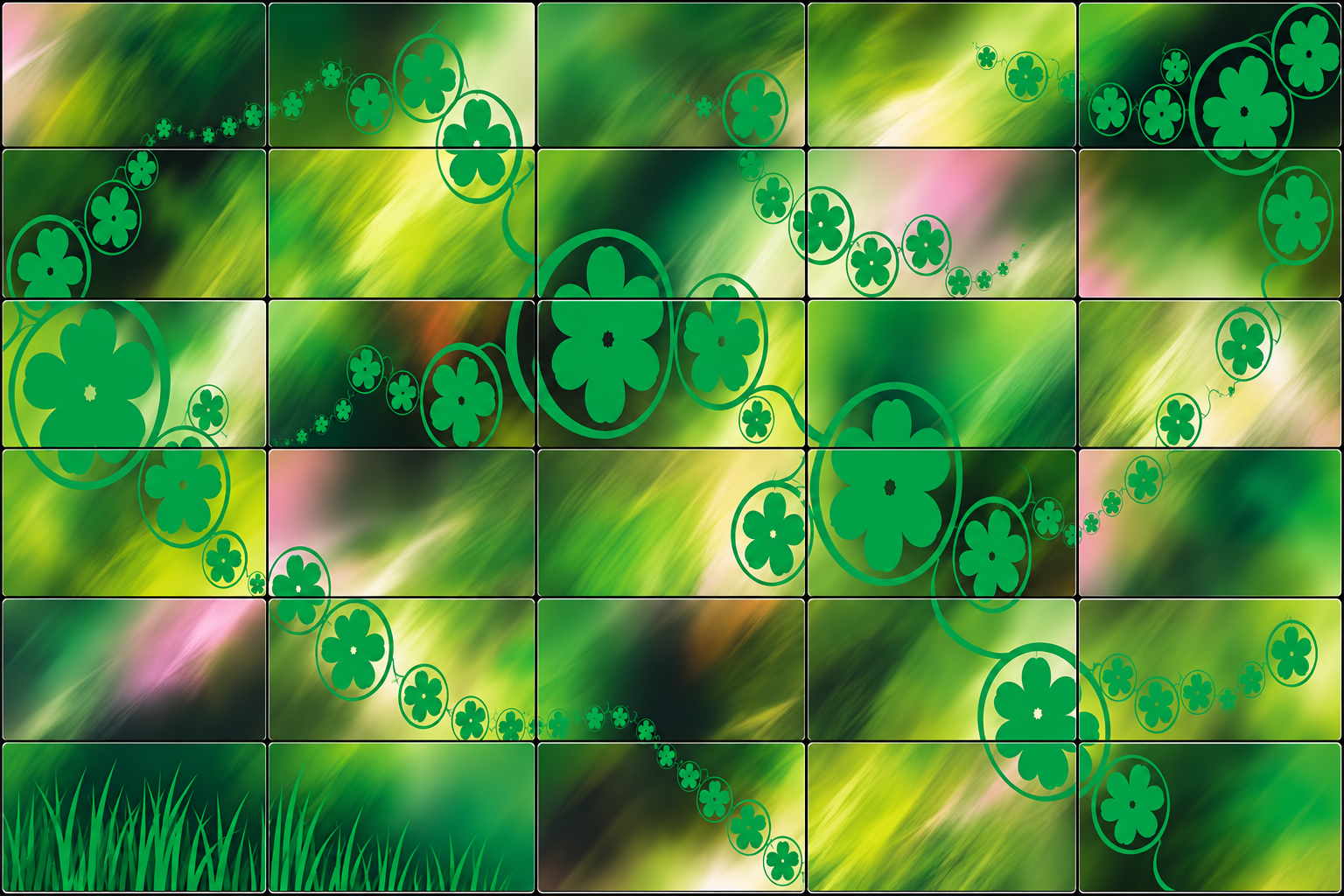
The aim is to create a floral composition by assembling the cards like pieces of an imaginary puzzle. There is no single correct solution: look for continuities in shapes, colours and movement to create a harmonious whole. Your picture may simply be beautiful… or become a more personal creation representing an emotion, an idea or a part of yourself. With several players, it can also become a collective work, with each person bringing their own sensitivity to the composition.
Here is an example:
7 – Floral Field
Objective
To deepen self-awareness and the quality of sharing within a group, first through intuition and feelings, then through reflection.
Set-up
Spread all the cards face up on the floor.
How to play
Each participant chooses the card they identify with most at that moment. Everyone then shares their choice; at first, the others simply listen. Once everyone has spoken, participants may add a positive comment.
8 – Floral Battle
Set-up
Deal all 72 cards. Each player places their cards in a pile in front of them, face up.
How to play
Each player takes the top card and places it face down, with the clover side showing. The player with the most clovers wins the cards. Count both whole clovers and those cut by the edge. 1 clover = 1 point, with a maximum of 10.
Floral Battle
In the event of a tie, the players involved draw one card and place it face up on the previous card. Each player spontaneously says a positive sentence related to their card.
They then draw a second card and place it face down to break the tie. If there is another tie, repeat the process. The winner is the player who eventually wins all the cards.
9 – Floral Castle
Set-up
Deal all the cards to the players.
How to play
In turn, each player places one card face up to build a floral castle together. Cards may be stood on their edges and leaned against one another: there is no need to recreate a traditional house of cards.
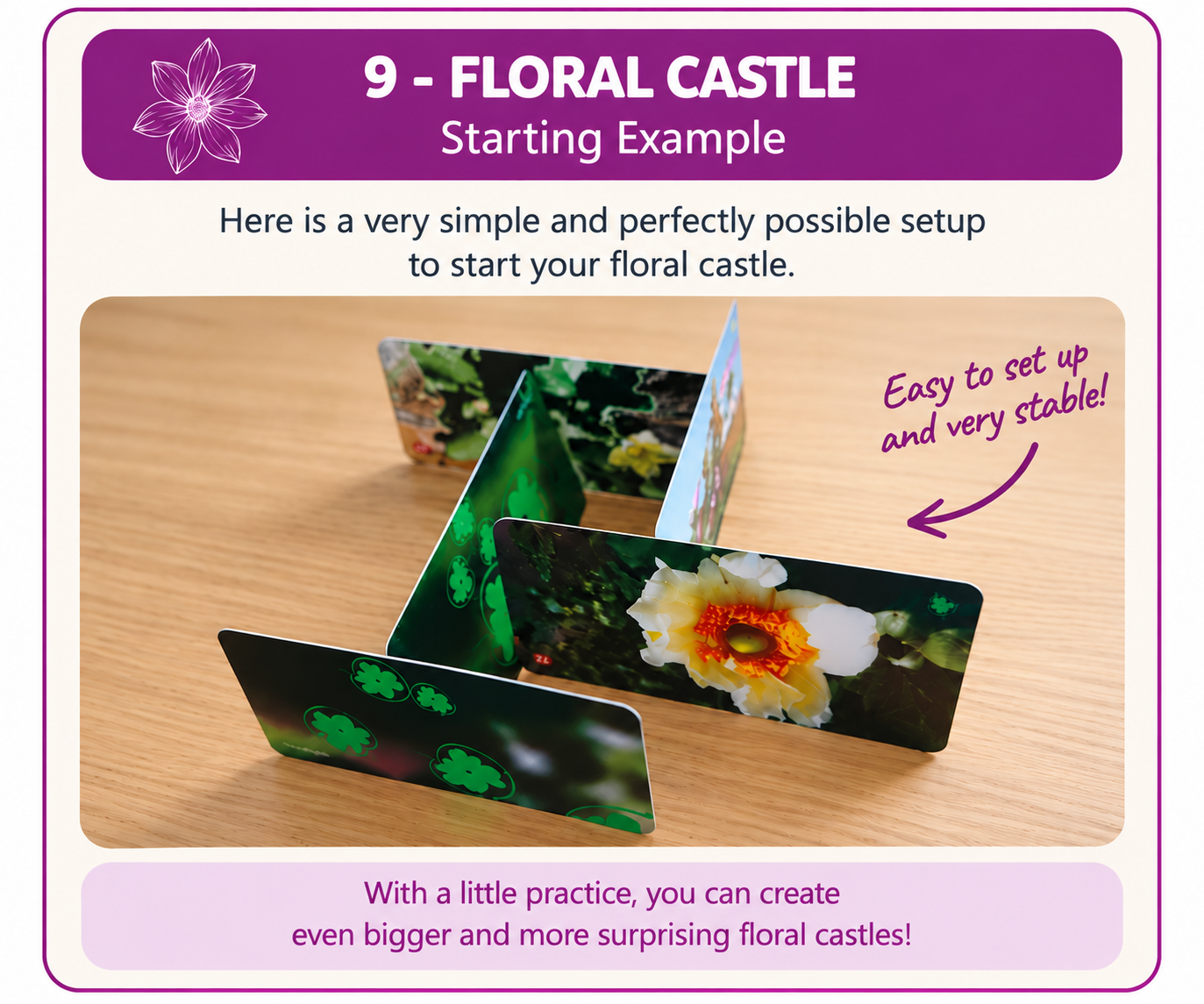
If a player knocks down all or part of the castle, the construction starts again.